|
|
Posts: 17
| I have spent considerable time trying to find in print why musky follow. Information about guarding an area during spawn is available, but little else to detal the rest of our season.
Curious if anyone else has studied the feeding of musky/largemouth bass in tanks. Appears to me that the majority of our presentations do not offer the attack angle that they prefer....... In tanks they almost always approach their target slowly until they are at their preferred attack position. Then they explode to grasp their prey behind the head. Seldom from the tail/rear. Exception is largemouth taking a smaller bait. They will then simply suck it in. Almost all other large prey targets are taken from the side. Easier for a musky to then reposition the bait to swallow head first.
My observations are stictly from first hand accounts while fishing, and youtube videos showing captive fish being fed suckers, trout etc.
Additionally, glider type baits seem to be one of the few offerings we present that come close to offering a good attack angle. Thus the importance of good figure 8's with other lure types to get the bait sideways for the following fish to attack as they prefer.
Anyone have any info they can share on this topic? Here in central illinois the fish are already starting their summer pattern of mind numbing follows with few takers. High fishing pressure is the main culprit.
Edited by vmikev 5/10/2010 8:53 AM
|
|
| |
|

Posts: 16632
Location: The desert | What makes you think they hit all the baits from behind?
Yes, I know what I did there. |
|
| |
|
Posts: 17
| "Then they explode to grasp their prey behind the head." From my post. Observations from video show most attacks from the side, grasping behind the head.
Call me dumb if you like, didn't post to get a riddle. No I don't know what you did there. |
|
| |
|
Posts: 16632
Location: The desert | I understand, and there is literature out there defining the way esocids attack prey. But your post seems to indicate that you believe that our bait presentations dont allow muskies to strike from the side. Simply because they follow from behind doesn't mean they can't hit it from another angle. |
|
| |
|
| I would bet muskies are very opportunistic and will attack a victim from any angle if it looks like a good meal. They follow because they are curious or undecided as to how safe it is to strike. |
|
| |
|

Posts: 2893
Location: Yahara River Chain | Just why do they stalk like cats? And why don't dogs stalk like cats? It just may be the nature of the animal - period, something that has been to their advantage for years. I just enjoy watching them do stuff like that and don't question why. Do you go throw this phase when dealing with women too??  |
|
| |
|
Posts: 17
| "Anyone have any info they can share on this topic?" Links or authors would be appreciated. Will expand my search to see what I get for hits on "esocids attack prey". |
|
| |
|

Location: SE Wisconsin | <p>. Sorry, see below - repost.</p>
Edited by Sam Ubl 5/10/2010 9:41 AM
|
|
| |
|
Posts: 16632
Location: The desert | vmikev - 5/10/2010 9:23 AM
"Anyone have any info they can share on this topic?" Links or authors would be appreciated. Will expand my search to see what I get for hits on "esocids attack prey".
Search google scholar. I don't have the articles on hand on this computer otherwise I'd give them to you, but searching google scholar will give you a myriad of results. |
|
| |
|
Location: SE Wisconsin | You come to expect that from PP...
I think when you detail around the 'preferred' attack angle for striking musky, you're hot on the trail of why it is that they follow... Waiting for the slip-up so they can take advantage with ease - like a wolf who chases a calf caribou for 10 miles until the thing trips up or tries juking the wrong way before the wolf ends the chase.
Maybe it's the catnip affect from the dinner bells displacing water in such a way it can only be associated with the feel of a baitfish. A wounded baitfish swims differently than a healthy one - maybe more/different tail paddling - hence -art of the attraction of the thumping big blades?? Rarely do you see a healthy baitfish swimming straight over or ripping through the weeds... That causes a commotion, which rings the dinner bell that rattles the cage of a musky lying in wait. They come to investigate, hot on the trail of the "lure", waiting to see what happens next.
Think about it, why would a musky follow from 30 feet out, only to strike during a series of boatside ovals? When a baitfish is injured or dying, you see them dance and do all sorts of weird stuff like swimming in circles, darting this way and that, etc. Another reason why lures like the Reef Hawf are so excellent. Their erratic 'behavior' induces the strike the entire retrieve back to the boat, while a bucktail may entice the follow, but the figure-8 induces the strike.
|
|
| |
|
Posts: 17
| Found what i was lookinig for, thanks for pointing me in the right direction. |
|
| |
|

Posts: 485
Location: On my favorite lake! | I believe some is out of hunger and some is being the top predator and chasing other fish out of their territory. If the fish or bait doesn't do what they want they attack it. |
|
| |
|

Posts: 1030
Location: APPLETON, WI | Sam Ubl - 5/10/2010 9:40 AM ...Another reason why lures like the Reef Hawf are so excellent. Their erratic 'behavior' induces the strike the entire retrieve back to the boat, while a bucktail may entice the follow, but the figure-8 induces the strike. Yes, to this. I think this just about sums it up. |
|
| |
|
Posts: 1169
Location: New Hope MN | Strike feeding behavior in the muskellunge, Esox masquinongy: contributions of the lateral line and visual sensory systems
JG New, L Alborg Fewkes and AN Khan
Department of Biology and Parmly Hearing Institute, Loyola University Chicago, Chicago, IL 60626, USA. [email protected]
The muskellunge, Esox masquinongy, is a predatory esocid fish with well-developed visual and lateral line systems. The purpose of this study was to determine the relative roles of these two sensory modalities in organizing the strike behavior of the animal. Subadult muskellunge were videotaped in a test arena while feeding on fathead minnows (Pimephales promelas). Animals were tested under five conditions: (i) control animals in which the visual and lateral line systems were intact; (ii) animals with lateral line afference suppressed by immersion for 12-24 h in 0.1 mmol l(-1) CoCl2; (iii) animals blinded by bilateral optic nerve transection; (iv) animals that had been unilaterally blinded; and (v) animals in which the lateral line system had been unilaterally denervated. The feeding behavior of the muskellunge consists of two phases: a slow stalk of the prey with minimal body movement followed by an explosive C- or S-start lunge at the prey. Quantitative comparisons of animals in the five test groups indicate that, although vision is used in the initial acquisition of the prey, both vision and the lateral line system play important roles in determining the initiation of the rapid strike. The lateral line system may play a critical role in the final capture of the prey at the end of the strike. In addition, lateral-line-suppressed muskellunge strongly alter their approaches to more distant prey. Bilaterally blinded muskellunge do not stalk their prey, but will lunge only at prey that are at close range. Unilaterally blinded or denervated muskellunge also alter their detection of and approach to prey, attending to a wider region of the intact sensory hemisphere. Our data suggest not only that the visual and lateral line systems play complementary roles in the feeding behavior sequence but also that each system plays a more or less dominant role during consecutive phases of the behavior.
|
|
| |
|
Posts: 181
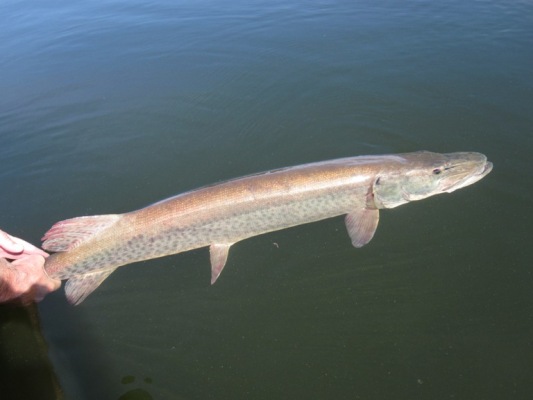
Location: Valparaiso, Indiana | I had one come in the other day and stop at the boat and stare at me....he stayed long enough for me to get a picture......
Edited by MuskyRuss 5/10/2010 4:43 PM
Attachments
----------------
 musky_003.jpg (269KB - 189 downloads) musky_003.jpg (269KB - 189 downloads)
|
|
| |
|
Posts: 75
| Russ you are lucky. There have been a number of studies that confirm if a musky is facing prey head and their tail curves a little to the right they are getting ready to attack.
From the picture it is clear he is sizing you up. |
|
| |
|
Posts: 100
Location: Bemidji/Cass Lake | Russ you missed an opportunity there to exercise the boatside tackle manuever. SPLOOSH!! |
|
| |
|

Posts: 422
| You should have tossed'em a tube, maybe he would have eatin? Sweet picture though.
Edited by 50"skie 5/10/2010 6:58 PM
|
|
| |
|

Posts: 169
Location: Houlton, WI | MuskyRuss - 5/10/2010 3:48 PM
I had one come in the other day and stop at the boat and stare at me....he stayed long enough for me to get a picture...... Thats a crazy picture, really getting me fired up |
|
| |
|

Posts: 32979
Location: Rhinelander, Wisconsin | 'Strike response' is based on how much response is acquired from your target to the stimulus offered. Be very careful not to anthropomorphize.
I've offered paragraphs on this in the past, I'll try to find it later. |
|
| |
|
Posts: 17
| Sworrall,
Anthropomorphize, no, working on a stored energy lure. Not sure if it's anything like what Dahlburg is working on. Appreciate any articles you can send my way.
Nice pic Russ, had one do that to us last year while fishing shallow crappie.
Edited by vmikev 5/11/2010 11:44 AM
|
|
| |
|
Location: SE Wisconsin | BenR, sure you've seen that, we all have - the idea for the inquiring is that their predatory insticts are to strike/attack at opportune times, such as a directional change or speed change, etc.
When you watch a musky follow a bucktail from way out, you give that bait a good pull to engage an increased speed change and what usually happens? From my experience, the reaction of the stalker is an intense and aggressive explosion of speed to ascertain the prey that now poses the ability to get away - a reactive strike response - surely from behind, but a reaction no less.
While attacking from behind without an influence, such as a hard rip from the angler, obviously does happen too, I'll sometimes eat my leftovers cold instead of heating them up... But I 'prefer' them warm more often than not, it depends on my mood.
If attacking from behind was a 'preferred' method of attack, then I suppose we should all give our forearms and shoulders a break from twitching, ripping and snapping. . .
Anyone fish suckers? How about a poll for Qty of suckers bit from behind versus from the side or headfirst. There's a prime example of prey that can't get away. It hangs there moving slowly with the boat. The musky has time to size it up and attack at the angle it prefers... How do they eat more often than not?
Let's consider another solid reason why muskies don't 'prefer' to eat from behind. . . Do we net a fish from the tail?? Nope - to risky for them to swim out or away and we risk missing them.
Edited by Sam Ubl 5/12/2010 10:38 AM
|
|
| |
|
Posts: 8880
| I think the short answer is they follow because our lures don't behave or sound anything like their normal prey does. There are times when they just eat, as soon as the bait hits the water, or after a few turns of the handle. There are also a LOT of times where they eat in the figure 8, in my opinion that's because the evasive move you just made triggers a strike. |
|
| |
|
Location: Contrarian Island | so they don't follow their normal prey???? yes, they do...
Edited by BNelson 5/12/2010 2:17 PM
|
|
| |
|
Posts: 16632
Location: The desert | Check your PM. |
|
| |
|

Posts: 12
| As someone who has kept many predatory South American fish in captivity, I'll tell you that fish will rarely attack their prey from behind. If they do, they will often injure the prey, spit it, and take it back in head first. A fish swallowed head first slides right down, a fish swallowed tail first had better be small enough for the fish to slide down spines and all. |
|
| |
|
Posts: 8880
| BNelson - 5/12/2010 2:15 PM
so they don't follow their normal prey???? yes, they do...
Right before they eat it... |
|
| |
|
Location: Contrarian Island | really ? huh, i've seen muskies following suckers around for a lonnng time and they never eat it... even when the sucker goes crazy and the musky has the so called perfect attack angle from the side... something tells me they also follow suckers/redhorse/ciscoes/whitefish/baitfish around too at times and do not eat them....the thinking to me that they follow our baits because they sense it's not real is flawed imho.
Edited by BNelson 5/12/2010 3:26 PM
|
|
| |
|
Posts: 32979
Location: Rhinelander, Wisconsin | Stimulus/response.
All the variables that influence the above in play.
End of story. |
|
| |
|
Posts: 16632
Location: The desert | BNelson - 5/12/2010 3:24 PM
really ? huh, i've seen muskies following suckers around for a lonnng time and they never eat it... even when the sucker goes crazy and the musky has the so called perfect attack angle from the side... something tells me they also follow suckers/redhorse/ciscoes/whitefish/baitfish around too at times and do not eat them....the thinking to me that they follow our baits because they sense it's not real is flawed imho.
I'll echo this point as well. I've had a fish follow a sucker as far as the wind would push me and it never ate. Figure 8'd the sucker, nothing. I even called a few people to see if they had any ideas. After a few conversations and no strike I gave up on it and pulled in the sucker. The fish soon disappeared. I went back to where I first brought this fish up to the boat about 2 or so hours later....same fish came up and same result. |
|
| |
|
Posts: 541
| carpediem - 5/12/2010 2:40 PM
As someone who has kept many predatory South American fish in captivity, I'll tell you that fish will rarely attack their prey from behind. If they do, they will often injure the prey, spit it, and take it back in head first. A fish swallowed head first slides right down, a fish swallowed tail first had better be small enough for the fish to slide down spines and all.[/QUOTE
I know some fish can spit and take things down then head first but I don't know if esox do probably not that often anyway! I do know however I have seen them do it but they reposition it in their mouth, I have seen them do it with sunnies bitten from the side! actually if you go on youtube and look you will see people with crippled panfish and such in front of them and muskies and pike just plain smashing them from every wich angle! |
|
| |
